
Key facts
Director of National Intelligence Jay Clayton said Sunday it was “entirely appropriate” for President Donald Trump to call Russian leader Vladimir Putin his friend.1
Clayton defended comments that Democrats have characterized as a betrayal of American values after Trump met with Putin and Chinese President Xi Jinping for rare three-way talks.1
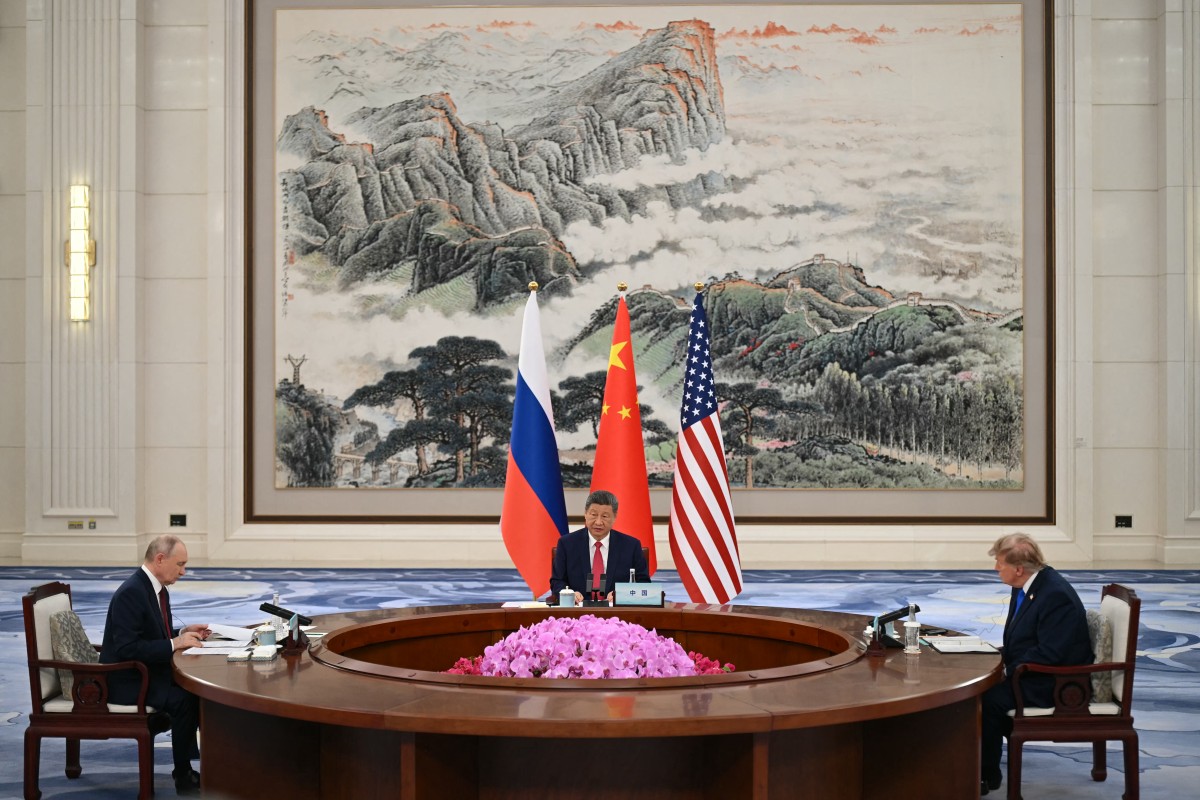
The summit last week in China seemed to be more symbolism than substance, but Trump and his top aides have described it as a historic gathering of the three countries with the largest nuclear arsenals.1
A warm welcome and a handshake
Trump raised eyebrows with his warm greeting of Putin and repeated references to him as his “friend.”1
That continued on Saturday, when the Republican president posted an image on Truth Social of him shaking hands with a smiling Putin under the caption, “My Friend.”1
Clayton said on ABC’s “This Week,” “In that circle — in that circle of that conversation, using the term ‘friend’ is entirely appropriate.”1
In an appearance on the ABC News show “This Week,” journalist Jonathan Karl pressed Clayton on Trump’s recent remarks.2
A historic meeting
Clayton said it was “historic” and “remarkable” for Trump to meet with the presidents of the other leading nuclear powers.1
Clayton declined when pressed to characterize Putin as a friend of the United States, noting Russia’s invasion of Ukraine.1
A defining relationship
Trump’s fondness for Putin has been a defining characteristic of Trump’s two terms as president.1
Trump beamed when meeting the Russian leader last week.1
After returning to Washington, Trump made no effort in the White House briefing room on Friday to walk back the comments.1
Trump noticeably sidestepped a specific question about whether he views Putin as a friend to the U.S.1
“I consider him to be somebody that I have a very good relationship (with),” Trump said.1
Trump immediately shifted to his “very good” personal relationship with Putin.1
A rare gathering
Trump, Putin and Chinese President Xi Jinping had a first-ever confirmed meeting on November 19.2
Senate Democratic leader Chuck Schumer of New York criticized the summit as a “historic embarrassment” for the United States.1